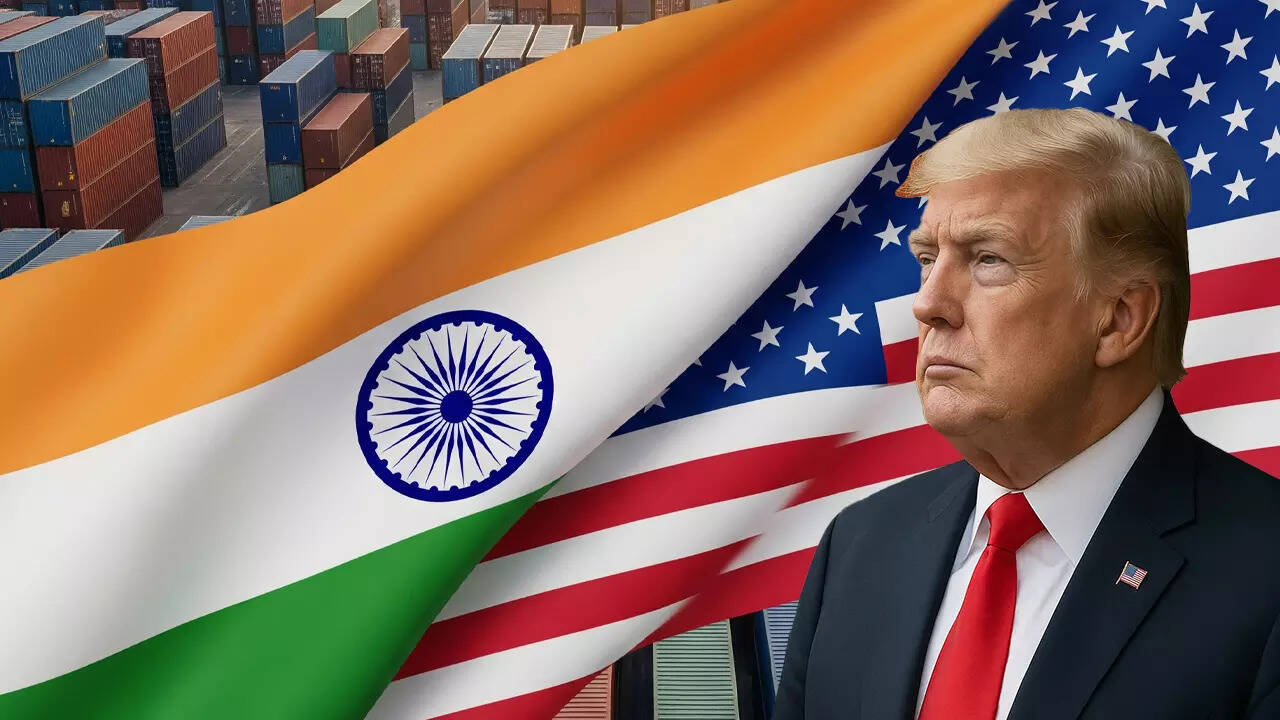
President Trump has threatened to impose 25% tariffs on India if a trade agreement cannot be achieved by the deadline of August 1.
In the event that the two nations are unable to reach a trade agreement by August 1, US President Donald Trump has threatened to impose tariffs on India of up to 25%.
In response to a question on Tuesday about whether India would be subject to increased tariffs in the absence of an agreement, Trump said, “Yeah, I think so.” Despite being a good buddy, India has essentially raised its tariffs more than any other nation. But now that I’m in command, you just cannot do that.
The United States has warned a number of other nations to establish trade agreements by August 1st or risk higher import duties.
Both sides have alternated between cautious and enthusiastic stances over months of negotiations between the US and India on a possible accord. Even as the deadline approaches, a definitive agreement is still elusive.
Trump has previously called India a “tariff king” and a “big abuser” of trade relations, and Washington has long accused the nation of protectionist practices and high tariffs.
In contrast to more than a dozen other trading partners, Trump has not yet formally sent India a tariff notice, but his administration has hinted that penalties may be applied quickly if negotiations break down.
In order to allow for more conversations, Trump temporarily halted his announcement in April that he would impose tariffs of up to 27% on Indian goods.
“We continue to communicate with our Indian counterparts,” said US Trade Representative Jamieson Greer earlier this week. We have consistently had fruitful conversations with them.
Although a settlement previously appeared “imminent,” Greer recognized that India’s long-standing protectionist posture had impeded negotiations.
He pointed out that “their trade policy has been premised on strongly protecting their domestic market,” and that Trump is concentrating on accords that increase the amount of international markets that are open to US goods.
Agriculture is a key point of contention. According to the United States, India’s agricultural sector is a valuable but untapped export market. But India has justified its agricultural laws on numerous occasions, pointing to worries for the livelihoods of millions of small-scale farmers and food security.
In an interview with CNBC last week, Indian Commerce Minister Piyush Goyal reiterated that stance, saying, “The agriculture sector is sensitive for India,” and promising that the government would make sure farmers’ interests are “well protected.”
Notwithstanding the conflicts, Goyal has voiced cautious optimism. He stated that India was making “fantastic progress” in trade negotiations and that he planned to “conclude a very consequential partnership” with Washington in the near future.
With bilateral trade exceeding $190 billion in 2024, the US was India’s biggest trading partner until recently. The goal of raising that amount to $500 billion was previously shared by Indian Prime Minister Narendra Modi and President Trump.
India has already agreed to lower tariffs on a number of US products, such as motorbikes and Bourbon whiskey, but the US still has a $45 billion trade deficit with India, as Trump has stated again and time all over.
As the deadline draws near, everyone is watching Washington and Delhi to see if the long-awaited deal will be reached or if a fresh round of trade disputes is about to break out.