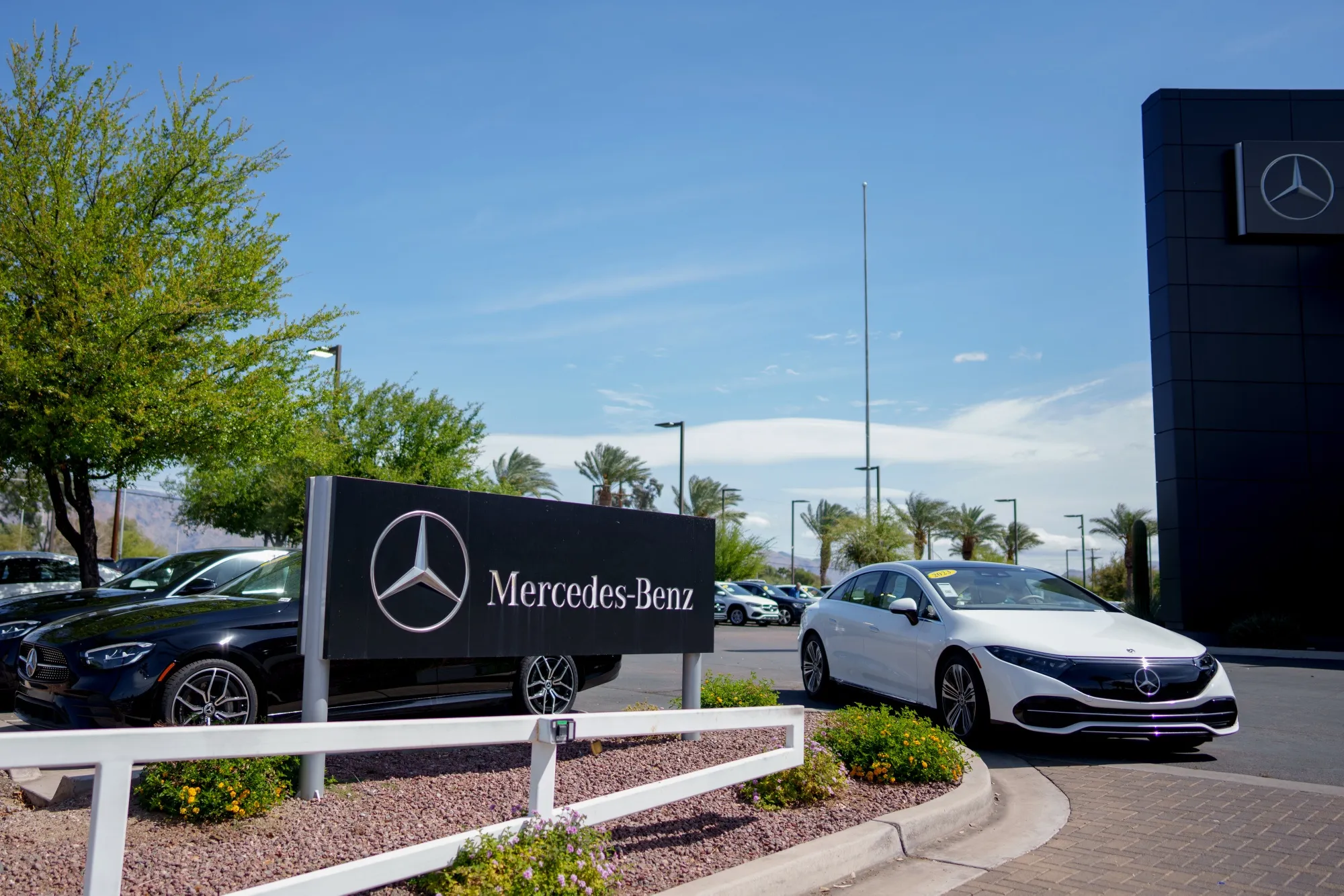
Mercedes-Benz lowers its profit margin projection due to $420 million in tariffs, declining sales in China, and a slowdown in demand for cars worldwide.
Citing a nearly $420 million damage from tariffs and wider trade tensions prompted by US President Donald Trump’s trade war, Mercedes-Benz has reduced its 2025 profit margin prediction for its automobile segment to 4–6%.
Prior to this, in February, the German luxury carmaker had predicted a profit of 6–8% for the year, but that figure did not take the tariff burden into consideration. The business completely retracted the guidance by April.
In its first firm estimate since the US-EU trade agreement was reached, Mercedes now estimates that tariffs would reduce its margin by about 150 basis points, which translates into operating profit losses for its car division of €362 million ($418 million).
The United States and the European Union narrowly avoided a full-scale trade war over the weekend by reaching a framework agreement. The European Union pledged to lower non-tariff barriers on American automobiles and other commodities, and the United States agreed to levy a 15% import duty, half of the 30% that was first threatened, on the majority of EU exports.
Although the result was better than anticipated, Mercedes admitted that its financial performance would still be negatively impacted by the reduced tariffs. “The margin would still be on the lower end of our initial guidance, excluding tariffs,” a firm representative stated.
You can already see the damage. At €1.99 billion ($2.30 billion), Mercedes-Benz’s adjusted EBIT for the second quarter dropped by more than 50%. After accounting for tariffs, internal efficiency issues, and a €750 million loss related to an Argentine plant sale and reorganization, reported EBIT fell even further to €1.27 billion.
In addition, revenue dropped 9% to €33.15 billion due to a decline in car sales and trade expenses.
Mercedes’ growth engine, China, is now contributing to the issue. Car sales in the biggest auto market in the world fell 10% in the first quarter and 19% in the second, due to increased local competition, higher premium prices, and a slower adoption of electric vehicles.
The US-EU trade agreement was hailed by Germany’s Chancellor Friedrich Merz, who said it helped shield the export-driven German economy from more serious damage. With a large portion of its US exports coming straight from Europe, Mercedes stands to gain more than its competitors that produce more in North America.
Despite having a sizable US plant in Tuscaloosa, Alabama, the automaker has not been able to counteract the worldwide slump.
Mercedes anticipates that its group revenues in 2025 will be much lower than those in 2024, as pressure mounts on both its car and van operations.