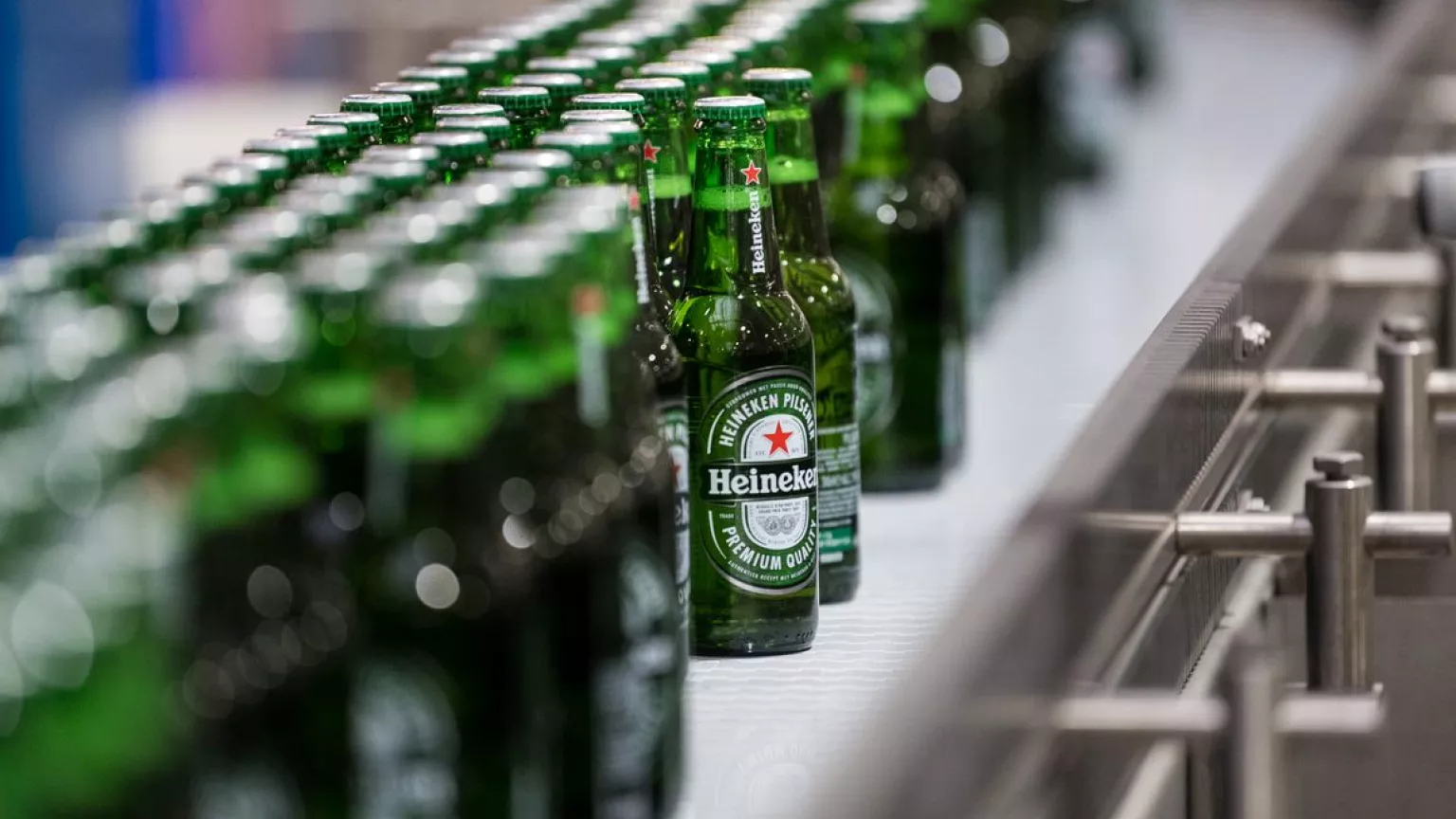
Dutch brewer Heineken’s shares fell more than 8% on Monday as market concerns over second-half profitability and volumes—which Heineken warned may be softer as tariffs impact on confidence—overshadowed a profit increase that topped forecasts.
The second-largest brewer in the world praised a trade agreement between the US and the EU and announced on Monday that it was considering all ways to address the long-term, increasing tariff issues, including moving production.
Although its first-half profit increased by 7.4%, exceeding analyst projections, its shares ended the day down 8.45%. It attributed this increase to cost savings and growth in previously challenging markets such as Africa and Asia. However, sales of beer fell 1.2%.
Heineken’s warning that volumes would be lower than anticipated for the rest of the year as U.S. President Donald Trump’s trade attacks damage markets in the Americas was cited by analysts and investors. Meanwhile, European sales were negatively impacted by a price dispute with retailers.
The company sells beer from Europe and Mexico, particularly its namesake lager, to the United States. It has also been negatively impacted by the indirect decline in consumer confidence in important countries, such as Brazil.
CEO Dolf van den Brink praised the confidence provided by the trade agreement reached on Sunday, which lowered a potential 30% U.S. tariff on EU exports to 15%, a rate that would still negatively impact Heineken’s U.S. earnings.
Although certain sector players, like producers of spirits, are hoping for an exemption, beer does not seem to have much chance of this happening.
Shifting manufacturing is one of the solutions being explored to reduce tariffs in the long run, he said, but he cautioned that such actions were expensive and would require greater policy coherence first.
“We consider every possibility, whether it’s sticking with our current configuration, a more hybrid version, or something else,” he said to reporters on a call. “If and when we deem them financially to be more attractive in the mid- to long-term, we would for sure explore them.”
Fears of a lingering tariff and economic uncertainty
Heineken’s Mexican-made goods could still be subject to U.S. tariffs of up to 30% unless the Mexican government and Washington can come to a deal before August 1.
Since the first quarter, Heineken has also witnessed economic uncertainties impact confidence and expenditure in the United States, Brazil, and Mexico, executives told reporters.
Sales in the beer sector in Mexico have been impacted by the sharp decline in U.S. remittances. Also, according to van den Brink, U.S. Hispanic consumers were spending less.
Heineken is still anticipating a 4% to 8% increase in profits annually.
Additionally, the company exceeded second-quarter revenue and volume projections, grew in areas such as Vietnam and India, and raised its annual cost-saving target by 25% to 500 million euros ($586 million).
“They have slightly downgraded their volume guidance,” Ryann Dean, a global analyst at Aylett Fund Managers, a Heineken investor, wrote. “Given everything going on in the world… that to me doesn’t feel like a terrible outcome.”
He added that Heineken’s steady profitability and robust expansion in places like China and India more than made up for this, and that Heineken’s long-term volume growth would be driven by emerging markets.
Brokering Jefferies was similarly taken aback by the steep decline in share price, which it attributed to concerns about weaker sales and slower profit growth in the second half.
“This represents an attractive buying opportunity in our view, given volume reassurance and profit delivery underpinned by delivery on the cost programme,” the note added.