China announced on Saturday that it would like to establish an organization to promote international collaboration on AI, presenting itself as a rival to the United States as the two countries compete for control of the game-changing technology.
At the biennial World Artificial Intelligence Conference in Shanghai, Premier Li Qiang stated that China wishes to share its advancements and assist in coordinating international efforts to control rapidly developing AI technology.
On Wednesday, the administration of President Donald Trump unveiled an AI roadmap that aims to significantly increase U.S. AI exports to allies in an effort to keep the United States ahead of China in the vital technology.
Although Li did not specifically mention the US, it seemed to allude to Washington’s attempts to impede China’s AI development, cautioning that the technology could end up being the “exclusive game” of a select few nations and businesses.
Li stated that China is eager to share its development expertise and products with other nations, especially those in the “Global South,” and that it wants AI to be freely shared and used by all nations and businesses. Lower-income, developing, or emerging nations—mostly in the southern hemisphere—are referred to as the “Global South.”
Li added that limitations included a lack of AI chips and limitations on talent exchange, raising additional concerns about how to control the growing hazards associated with AI.
“Global AI governance remains disjointed overall. Countries differ greatly from one another, especially when it comes to institutional rules and regulatory notions,” he remarked. “We should strengthen coordination to form a global AI governance framework that has broad consensus as soon as possible.”
Head Offices in Shanghai
With artificial intelligence (AI) emerging as a major battleground, the three-day Shanghai conference brings together policymakers and industry executives at a time when China and the United States, the two largest economies in the world, are engaged in an intensifying technical competition.
Washington, citing concerns that the technology could improve China’s military capabilities, has restricted the sale of advanced technology to China, including the most expensive AI chips produced by firms like Nvidia (NVDA.O), opens new tab, and chipmaking equipment.
China has continued to make advances in AI in spite of these limitations, which have caught American policymakers’ attention.
A roundtable of delegates from more than 30 nations, including South Africa, Qatar, South Korea, Germany, and Russia, was told by China’s Vice Foreign Minister Ma Zhaoxu that China wanted the organization to encourage practical collaboration in AI and was thinking of locating its headquarters in Shanghai.
The foreign ministry posted an action plan for global AI governance online, urging governments, businesses, research institutes, and international organizations to collaborate and foster global interactions, including through a cross-border open source community.
Government officials, investors, researchers, and prominent members of the industry are usually drawn to the government-sponsored AI conference.
Geoffrey Hinton, dubbed “the Godfather of AI,” former Google CEO Eric Schmidt, and Anne Bouverot, the French president’s special envoy for AI, were among the speakers on Saturday.
A new tab opens for Tesla (TSLA.O). This year, CEO Elon Musk, who has frequently attended the opening ceremony in person or via video in previous years, did not give a speech.
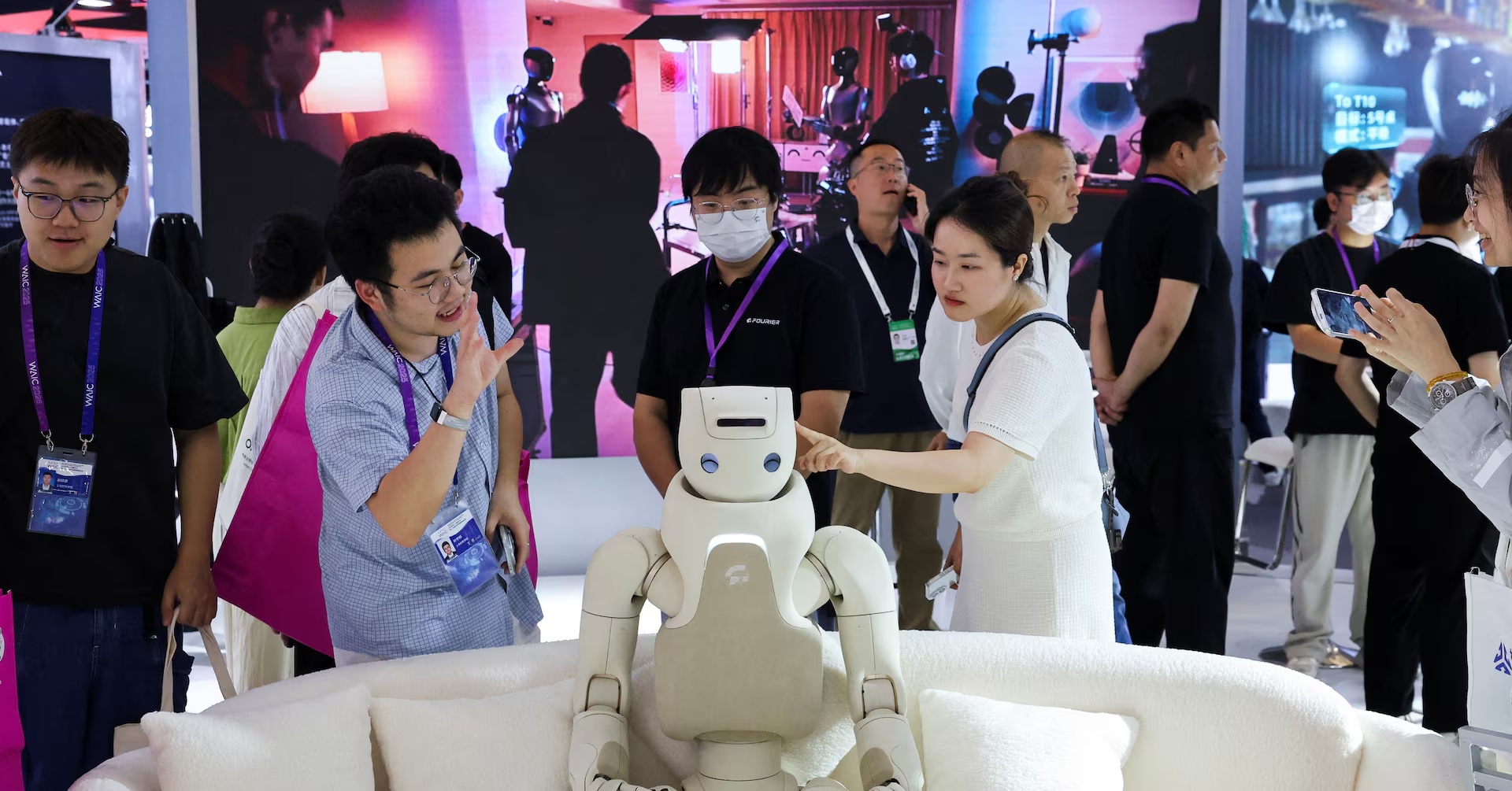
The conference includes seminars as well as exhibits where businesses showcase their most recent developments.
According to organizers, over 800 firms are taking part this year, exhibiting over 3,000 high-tech items, 40 huge language models, 50 AI-powered devices, and 60 intelligent robots.
A large number of Chinese enterprises are on display, including startups like Unitree, which makes humanoid robots, and tech behemoths Huawei and Alibaba (9988.HK). A new tab is opened by Amazon (AMZN.O), Alphabet (GOOGL.O), and Tesla, which are all Western participants.