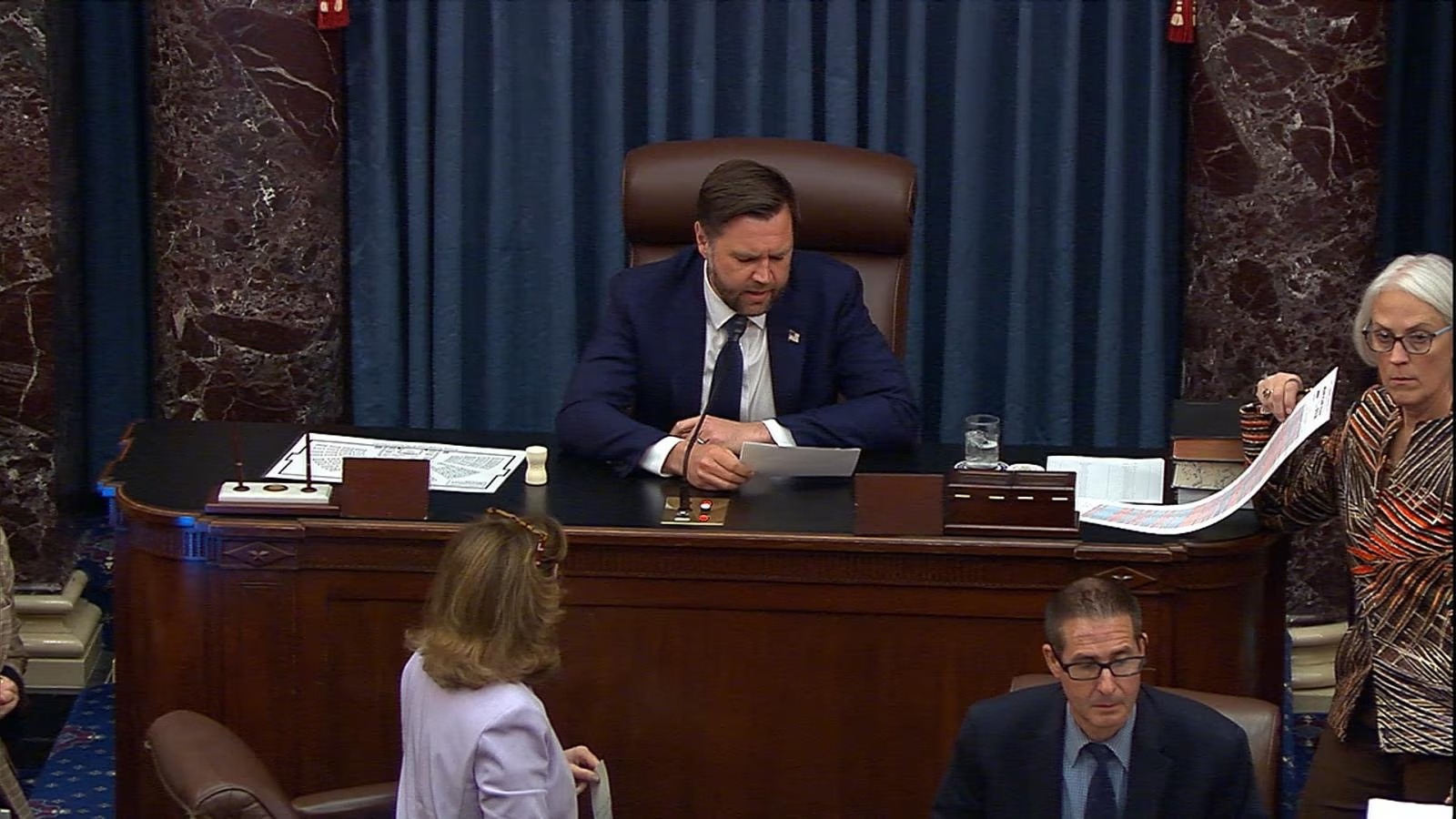
Vice President JD Vance throws the decisive vote to move Trump’s massive tax and spending measure forward in the Senate following a tie.
Vice-President JD Vance cast the crucial tie-breaking vote on Tuesday morning, narrowly passing former President Donald Trump’s historic tax and spending measure, known as the One Big Beautiful measure Act, after a long 24-hour debate and days of political squabbling.
After Vance broke a 50-50 Senate gridlock, the long-awaited legislation—a key component of Trump’s second-term economic agenda—passed one of its largest legislative obstacles. The bill will now be sent back to the House of Representatives for Senate amendment approval, which is expected to spark intense bipartisan discussion once more.
The vote revealed significant rifts within the party, despite Senate Majority Leader John Thune’s valiant attempts to mobilize Republican support. Senators Rand Paul (Kentucky), Thom Tillis (North Carolina), and Susan Collins (Maine) joined Democrats in opposing the roughly 1,000-page bill by voting against it.
Senator Lisa Murkowski of Alaska, who had previously voiced doubts, finally supported the bill, allowing the GOP to secure the 50 votes required for Vance to step in.
The bill aims to permanently implement the massive tax cuts that were implemented during Trump’s first term, while making significant changes to federal programs, such as healthcare and food aid for low-income Americans, to make up for the expected revenue deficit. The bill’s features, especially its effects on Medicaid and renewable energy subsidies, have drawn harsh criticism from Democrats.
Senate Democrats had previously insisted that clerks read the full law aloud, all 940 pages, followed by an hours-long “vote-a-rama” on changes in a symbolic bid to postpone its adoption. Nevertheless, the Republican leadership persisted, ending the discussion in time to meet the president’s deadline.
Trump acknowledged on Tuesday that it could be challenging to reach his earlier target of July 4 for Congress to send the final package to his desk. He told reporters, “I think it’s very hard to do July 4th, but I’d love to do it.”
Republicans only hold a slender majority in the House, which presents the bill’s next obstacle. Although a previous version was approved by a single vote, the most recent version has drawn criticism from a variety of groups, including moderate Republicans and fiscal conservatives who are worried about the extent of the planned cuts to social programs.
The plan may increase the national deficit by $650 billion a year, the House Freedom Caucus said. In a social media post, the group stated, “That’s not fiscal responsibility.” “We didn’t agree to that.”
Meanwhile, Trump’s well-known allies have also expressed reservations. Elon Musk, a tech entrepreneur who was instrumental in Trump’s 2024 campaign, publicly denounced the plan on Monday and blasted legislators for approving what he described as “the biggest debt increase in history.” As Trump’s “cost-cutting tsar,” Musk has hinted at starting a new political party and vowed to assist primary opponents of Republican lawmakers who support the plan.
Musk wrote on X (previously Twitter) that “every member of Congress who campaigned on cutting government spending and then immediately voted for this should hang their head in shame.”
Critics also object to the bill’s drastic reductions in incentives for electric vehicles and renewable energy, which could have an immediate effect on Tesla, a business that is strongly associated with Musk’s wealth.