Analysts say the Rwanda-Congo peace pact is hopeful, but Doha negotiations and political will remain crucial
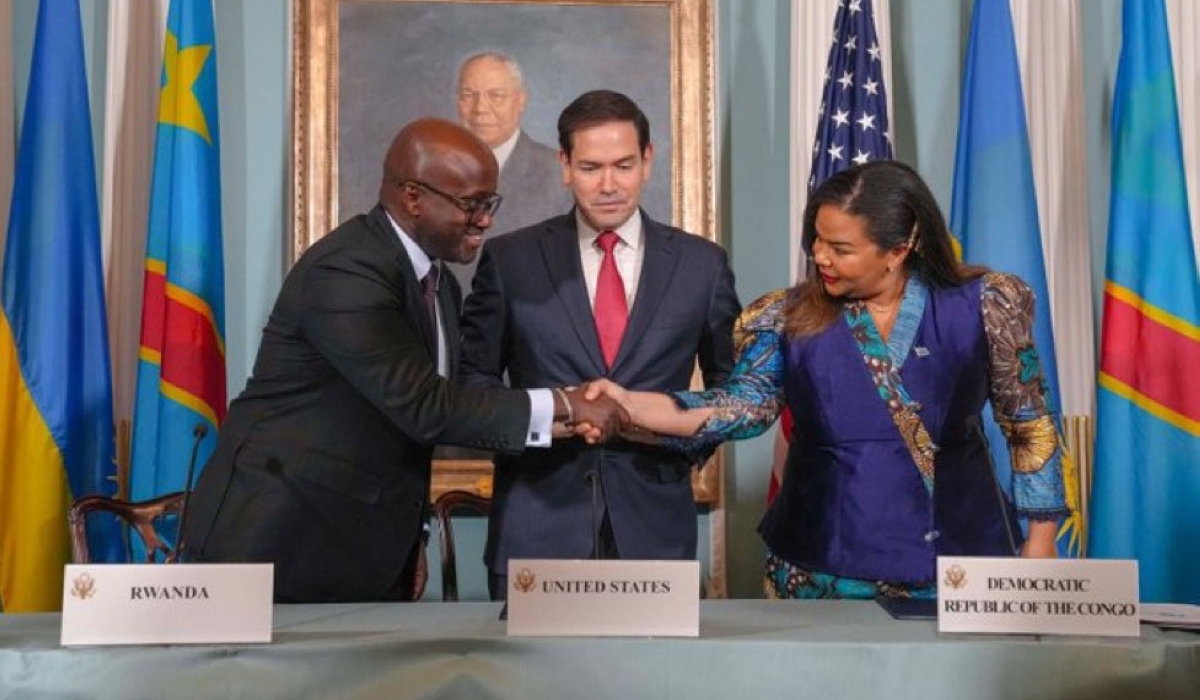
Analysts view the peace deal that Rwanda and DR Congo concluded on Friday, June 27 in Washington, DC, under US intervention, as a significant diplomatic achievement.
Its viability, however, depends on significant results from the current discussions between the Congolese government and the AFC/M23 rebels, which are being sponsored by Qatar, as well as political will from Kinshasa, which they contend has long been lacking.
In front of US Secretary of State Marco Rubio, Rwandan Foreign Minister Olivier Nduhungirehe and his Congolese counterpart Therese Wagner Kayikwamba signed the agreement, which places a strong emphasis on respecting each other’s territorial integrity, stopping aid to armed groups, and resolving conflicts amicably.
The accord specifically calls for the neutralization of the FDLR. Remaining members of the 1994 Genocide against the Tutsi perpetrators formed the US- and UN-sanctioned militia, which has been a security concern to Rwanda for roughly 30 years.
For execution and accountability, the agreement creates a joint security coordination structure and monitoring committee. It also lays the foundation for long-term peace and mutual prosperity by committing to promote regional economic integration and ease the return of internally displaced people and refugees.
“Resolving conflicts requires addressing domestic realities.”
“Some actors had previously skewed peace processes in favor of DR Congo while ignoring historical responsibilities tied to colonial powers like Belgium,” said Alex Mvuka, a Congolese researcher and regional political analyst, in an interview with The New Times on June 28. He praised the outcome of the US mediation.
The fact that this procedure has separated itself from European meddling is a good thing, Mvuka stated. From creating tribal divisions that target Kinyarwanda-speaking and Tutsi groups to redrawing borders that forced Rwandans into the Democratic Republic of the Congo, they are historically responsible, he added.
Mvuka underlined that the main internal factors still contribute to conflict in eastern DR Congo, namely inadequate governance and discrimination based on ethnicity.
“This seems to me more like a diplomatic ploy than a real answer. The majority of the problems are internal, which is why there are more than 200 armed organizations and the M23 insurrection has grown, he said. “The agreement lacks a strong foundation if the Doha mechanism is not incorporated into the Washington process.”
Mvuka pointed out that “DR Congo has a well-documented history of failing to honor peace agreements.” We’ve seen it abandon a number of regional frameworks that stood a much better chance of success. However, Rwanda is likely to carry out its end of the bargain, both because it is capable of doing so and because it may have a stronger desire for peace than the Kinshasa government.
Additionally, he maintained that Rwanda’s defensive actions were a reaction to clear
“FDLR’s ideology is like smoke.”
Mvuka expressed doubts over international mediators’ ability to comprehend the local situation.
It is provable that Rwanda has withdrawn its defensive measures. But how will the FDLR, whose homicidal ideology spreads like wildfire, and more than 250 armed factions be disarmed by the DR Congo?” he wondered. “Instead of using neighbors as scapegoats, Kinshasa must first take responsibility for its internal shortcomings.”
To create a long-lasting basis for peace, Frederick Golooba-Mutebi, an independent researcher and regional political analyst from Uganda, emphasized that two important pillars need to be addressed.
“It is crucial to neutralize the FDLR,” Mutebi stated. The security and well-being of Congolese Tutsis, many of whom it has killed, forcibly displaced, or forced into exile, especially to Uganda and Rwanda, are seriously threatened by this violent group, which is at the center of the conflict.
Due to their recurrent attempts at infiltration, “often with the tacit support or direct complicity of past Congolese governments,” he added, the militia also poses a threat to Rwanda’s peace and stability.
“The defensive actions taken by Rwanda as a result of these threats have increased tensions between the two countries.”
He also underlined how critical it is to address the domestic governance and security issues facing the Democratic Republic of the Congo.
“A sincere negotiating effort with the AFC/M23 is necessary to resolve these difficulties. The DR Congo may start to mend its internal divisions if these negotiations take into account the justifiable worries of the AFC/M23 and later those of other oppressed groups. He claimed that doing so would open the door to long-term peace, stability, and the pursuit of prosperity.
“The road to peace has at least been partially opened, but there are no guarantees,” he warned.
“It’s time for the UN to review its Congo mandate.”
There are still concerns about the legitimacy and objectivity of several UN organizations, even though the peace deal specifies their participation in promoting collaboration between the two nations, especially in easing the repatriation of refugees.
Concerns have been expressed by analysts over the UN’s prior biased assessments that seemed to support the Congolese government while unfairly singling out other conflict participants.
They contend that in order to make sure the UN peacekeeping mission in the Democratic Republic of the Congo (MONUSCO) is in line with the goals and spirit of the recently signed peace agreement, it needs to be carefully examined.
A member of the East African Legislative Assembly (EALA), Ambassador Fatuma Ndangiza, demanded a thorough evaluation of MONUSCO’s performance.
Ndangiza claimed that although UN missions have contributed, MONUSCO is currently falling short of expectations. “It runs the risk of becoming irrelevant or even contributing to the issue if it persists in its current form.”
In order to promote regional economic integration, she emphasized the significance of establishing safe conditions for the return of refugees and internally displaced people.
“To guarantee enduring peace, the FDLR must be dismantled by the DR Congo.”
According to Ndangiza, the signing of the peace deal between Rwanda and the Democratic Republic of the Congo marks a significant turning point that could usher in a new era of peace and stability in the Great Lakes area.
She said it’s critical to understand how the US-brokered agreement complements other current continental and regional peace initiatives, such as those spearheaded by Qatar and the African Union.
“This can be considered a strategic and timely initiative,” she stated. Of course, though, implementation is what we are all now anticipating. Although Rwanda might be open to reducing its defensive posture, it would be challenging to do so without the FDLR being neutralized or dismantled.
Regarding the FDLR situation, the US must make sure that all parties, particularly DR Congo, take the required actions to disband the organization. It would greatly aid in promoting peace and bolstering positive ties with Rwanda if it were accomplished.
Ndangiza praised the US government for being involved in the negotiations from the beginning.
In reference to Mass Boulos, the US president’s senior advisor for Africa, who traveled to the two nations in April prior to the start of intense negotiations, she said, “One positive example was the decision to send a special advisor to President Trump, not simply to draft reports from Washington, but to visit the region in person.”
The political will of Kinshasa
Former UN advocate and DR Congo conflict analyst Jean Baptiste Gasominari stressed that what now seems nearly impossible in the peace agreement between Rwanda and DR Congo might actually become a reality with true political will from Kinshasa.
“DR Congo allowed things to get worse,” Gasominari contended. Its political climate made it possible for the crisis to worsen. Therefore, development is totally achievable if the Congolese government reaffirms its political will and sincerely commits to carrying out the deal.
He claimed that the decision to include the FDLR in the national army and to use other armed militias in the fight against the AFC/M23 rebels was a political one, but that the same administration could change history and go back in time.
“This peace agreement seems to address the two countries’ concerns and reflects a shared desire for stability,” he stated. “But peace will remain elusive if the fundamental causes of the conflict—especially those that DR Congo attributes to Rwanda—are not fully addressed.”
“Resolving the grievances of Congolese citizens who have taken up arms to demand their rights should be the main focus.”